
Stella Forge: open concept for in-orbit vacuum metal additive manufacturing
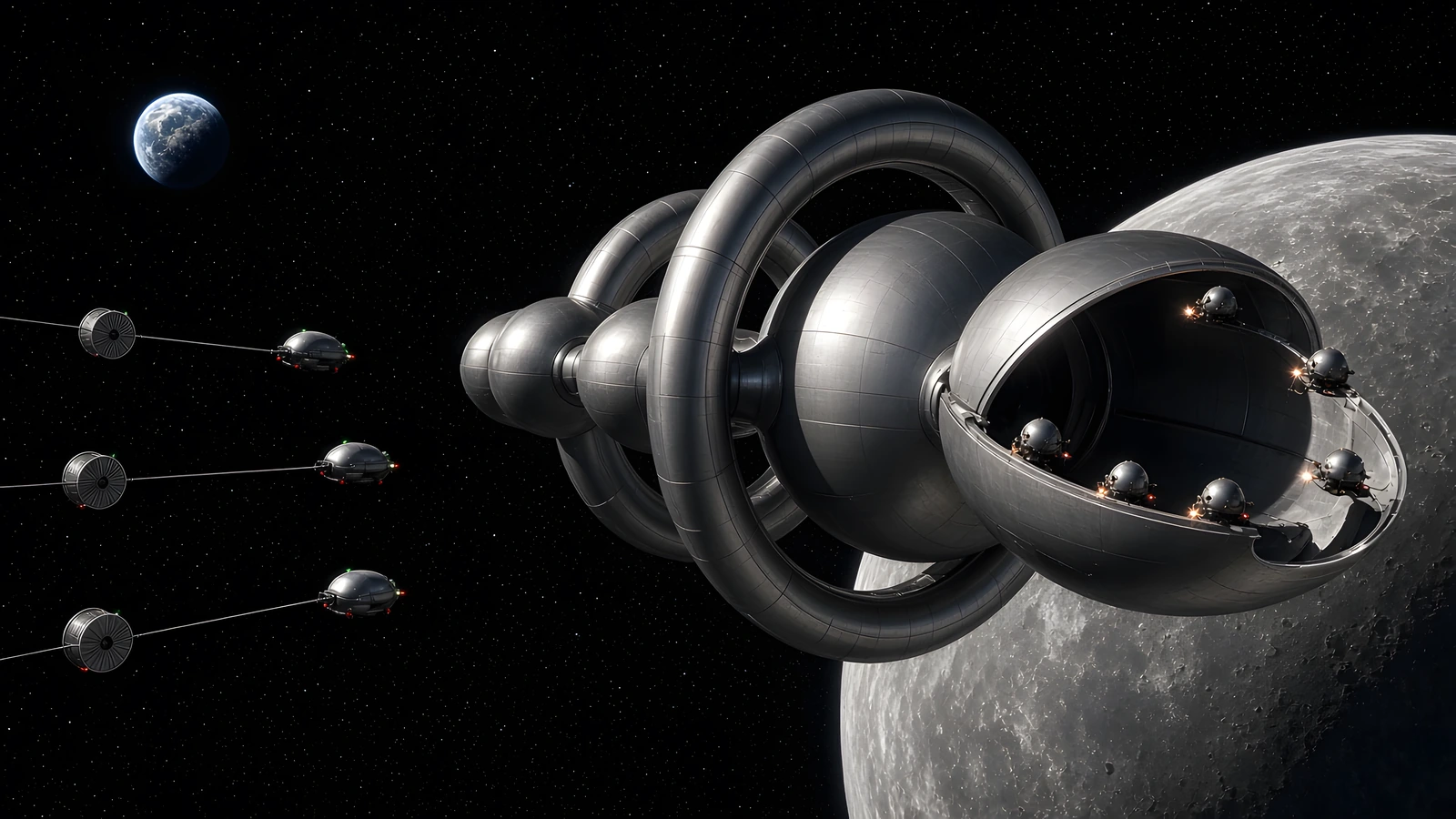
Stella Forge is an open concept for printing curved metal structures in orbit: wire feedstock, a resistive-laser hybrid energy source, and a print head that wraps the workpiece and recycles its own heat. This page publishes the v0.1 concept white paper in full, so that engineers, students, hobbyists and space gamers can pick it apart, improve it and build on it.
Status: Concept v0.1, October 2026. Open source (Apache 2.0). GitHub repository coming soon.
Stella Forge: An Open Concept for Vacuum Metal Additive Manufacturing in Orbit
Version 0.1 – Concept White Paper
October 2026
Author: Rick Timmis
Open Source – Apache 2.0
Executive Summary
Stella Forge proposes a practical path toward in-orbit metal additive manufacturing focused on curved (spherical and elliptical) structures. The concept uses a wire-only feedstock, a resistive-laser hybrid energy source, and a conformal print head that wraps the workpiece with contact pre-heater and cooler zones. Heat recovered from the cooler is transferred to the pre-heater to improve energy efficiency in the power-constrained orbital environment.
The approach aligns with the UK Space Strategy’s prioritisation of In-Orbit Servicing, Assembly and Manufacturing (ISAM). Designs, models, and process sketches are released open source on GitHub so that the wider community can contribute. Community participation is offered through tiered membership (not equity) aimed at space-simulation players.
1. Context and Opportunity
The 2026 UK Space Strategy places ISAM among its four priority subsectors, backed by dedicated funding and regulatory reforms intended to encourage novel missions. Current metal additive manufacturing demonstrations in space (ESA’s ISS laser-wire printer, NASA EBF³ electron-beam work, and emerging resistive/hybrid studies) have shown that wire feedstock is viable. Significant gaps remain in thermal management, process stability under pure vacuum, power efficiency, and the ability to produce larger structural elements.
Stella Forge targets these gaps with a deliberately constrained geometry and a thermally closed-loop print head.
2. Technical Concept
Process Architecture
- Feedstock: Metal wire only (no powder, no flux, no shielding gas).
- Energy: Resistive (Joule) heating of the wire combined with a low-power laser for precise melt-pool control and liquid-bridge stability.
- Environment: Hard vacuum. No reliance on gas.
- Geometry constraint: Spherical and elliptical forms only. This eliminates sharp corners, simplifies tool paths, reduces residual-stress concentrations, and enables continuous conformal contact with the print head. Pressure vessels, habitat modules, tanks, and many structural shells naturally fit this family.
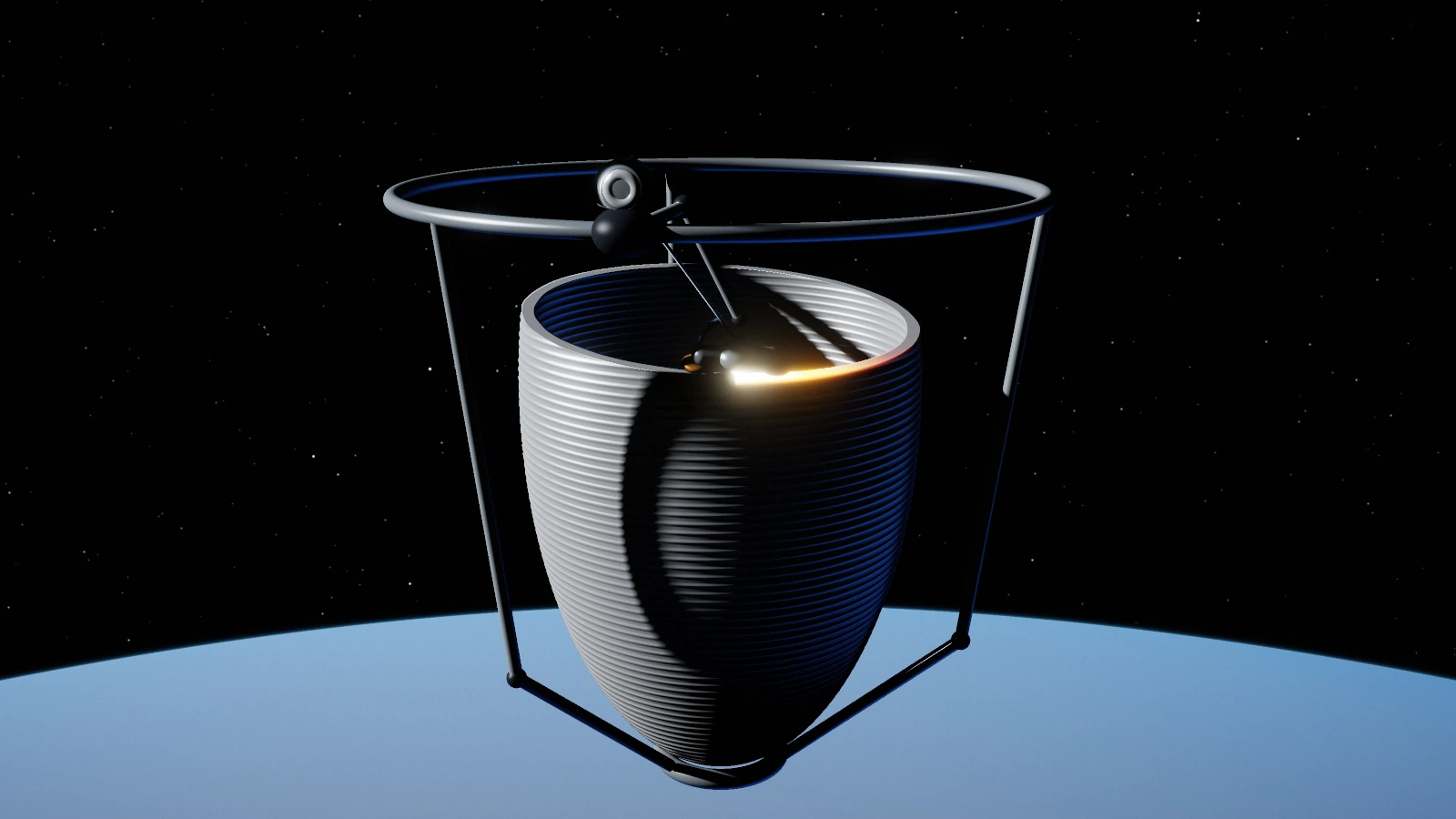
Concept (b): an elliptical shell being printed layer by layer in orbit.
Print Head
The head wraps or closely follows the curved surface and contains three sequential zones:
- Pre-heater – contact pads that raise local substrate temperature via conduction.
- Deposition zone – resistive + laser energy maintaining a stable liquid bridge from wire to workpiece.
- Cooler – contact pads that extract heat to control cooling rate and microstructure.
Heat extracted by the cooler is transferred (heat pipe, conductive path, or small loop) back to the pre-heater, reducing net power demand from the solar arrays. Contact force is managed actively or compliantly because microgravity provides no seating force. Surface cleanliness and cold-welding mitigation are design requirements.
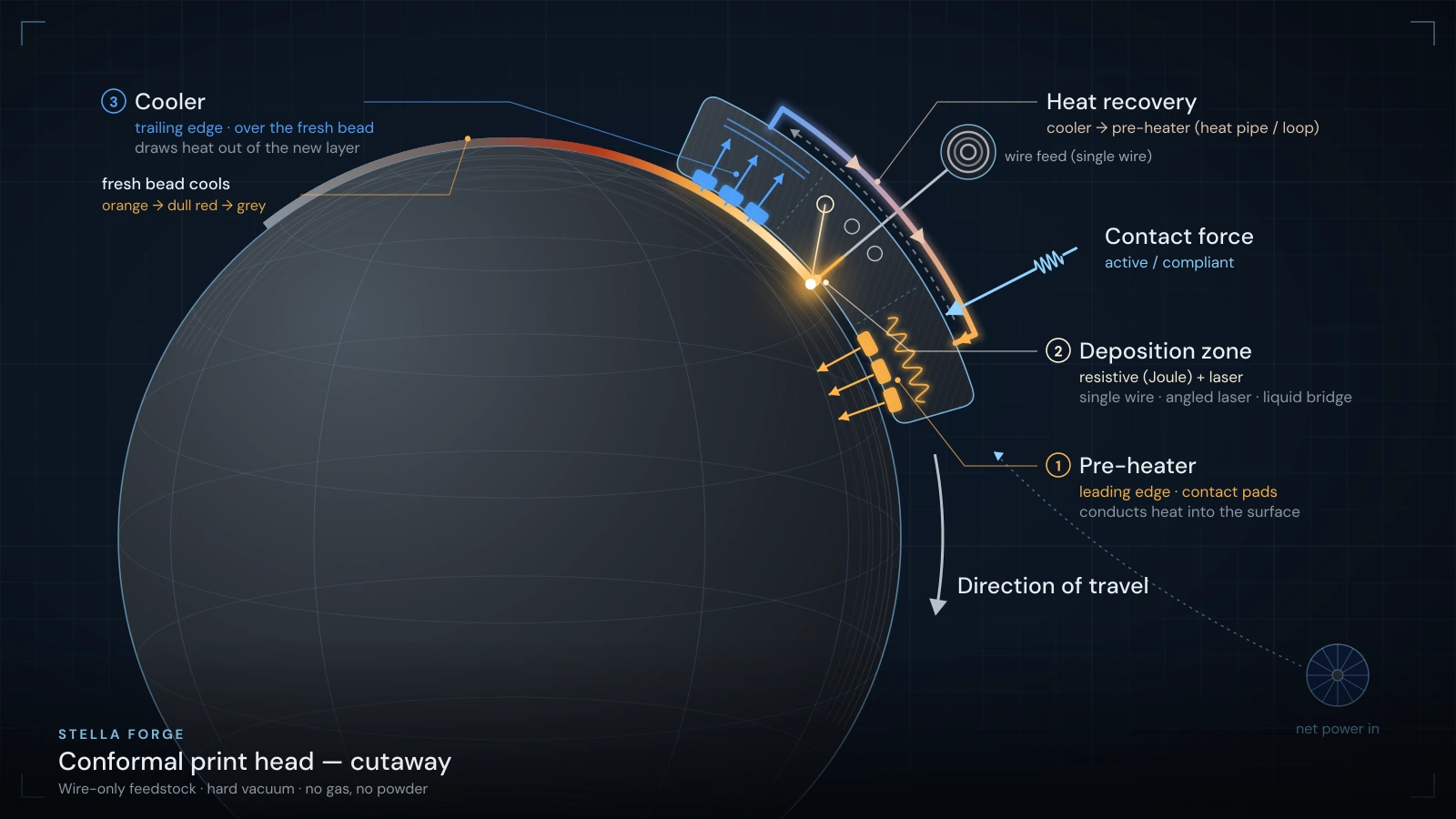
Concept (a): the conformal print head and its thermally closed loop.

Concept (d): a printer bot on the rim, its melt point leaving a bead that cools from orange to grey.
Process Physics Notes
Vacuum eliminates oxidation but increases metal evaporation rates. Process windows must keep peak temperatures below regimes that produce significant vapour or spatter. Microgravity alters melt-pool shape (more spherical free surfaces, reduced buoyancy-driven flow). Contact thermal control is used to compensate for the absence of convection.
Future vision
Section 3 of the white paper: Wider Vision.
Near term (TRL 1–4)
- Open models and thermal simulations.
- Vacuum-chamber breadboard of the contact head and heat-recovery path.
- Small curved demonstrator prints (centimetre to decimetre scale).
Medium term
- Robotic free-flying or station-mounted printer producing modular curved structural elements.
- Integration with existing ISAM servicing vehicles for repair and assembly tasks.
- Feedstock logistics experiments using high-capacity launchers.
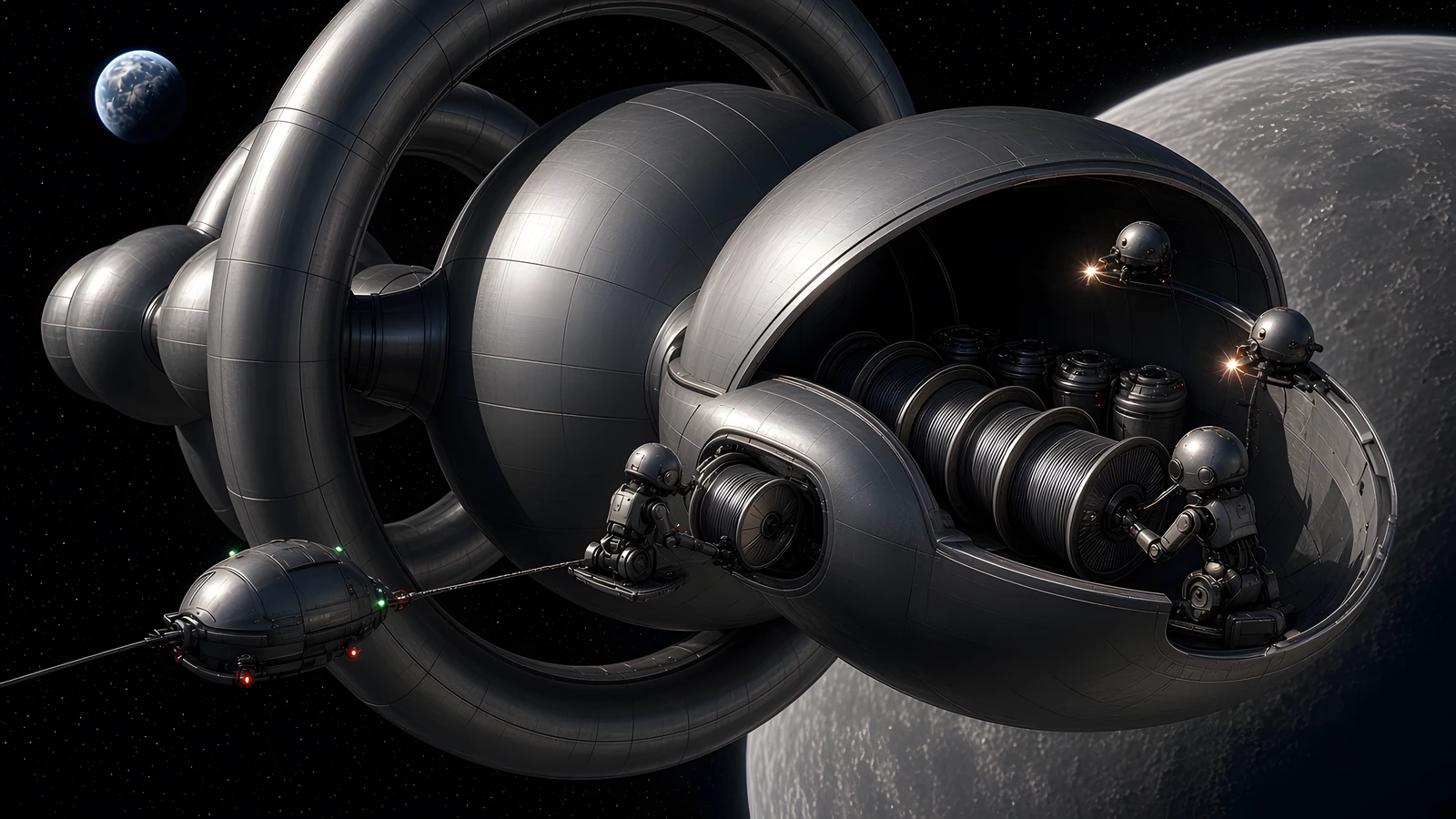
Concept (e): a drone delivering wire feedstock to the hull depot while bots unload it.
Long term
- Orbital production of larger shells and pressure vessels.
- Modular assembly of habitats, depots, or interplanetary craft components that exceed single-launch fairing limits.
- Contribution to a future in-orbit shipyard capability, built on open designs and iterative community improvement.
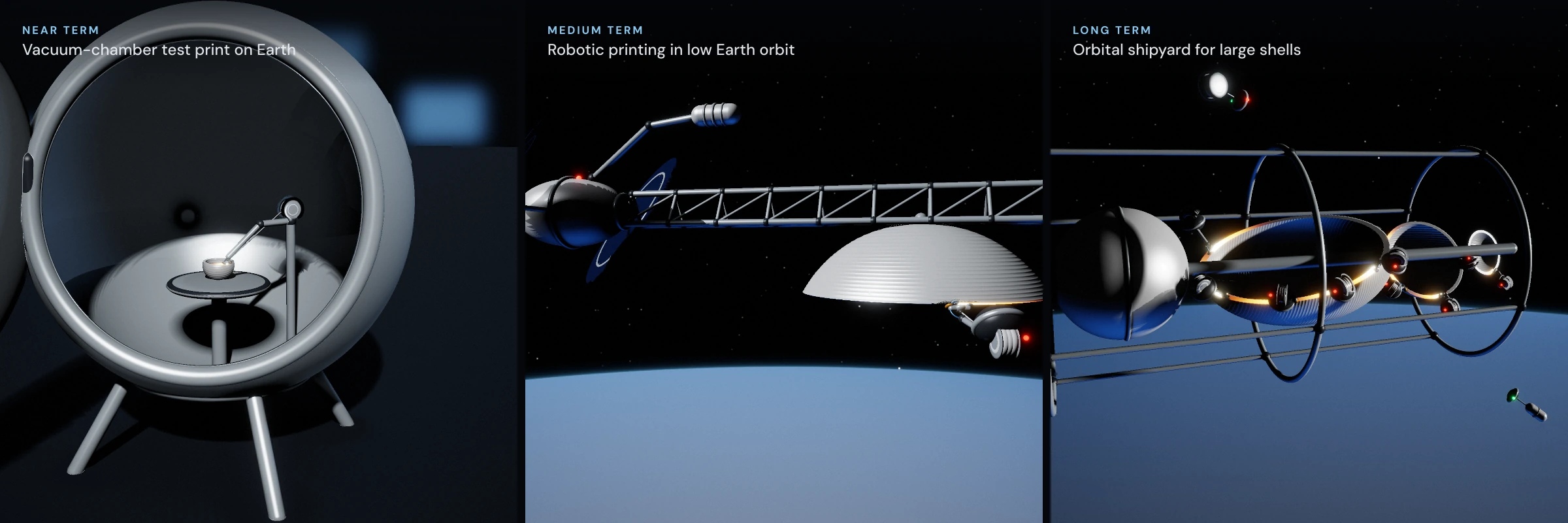
Concept (c): from breadboard to in-orbit shipyard.
The concept is deliberately modular so that software, control algorithms, head mechanics, and process data can advance independently.
4. Open Source and Community
All concept CAD, thermal sketches, process notes, and simulation code are released under the Apache 2.0 licence on GitHub. Contributions are welcomed from engineers, students, and hobbyists.
Community membership
Stella Forge Community Membership (rewards-based, not equity or shares):
| Tier | Rewards |
|---|---|
| £10 | Digital certificate, access to progress updates, concept art pack. |
| £25 | Above + early access to design files and non-binding feedback polls. |
| £50 | Above + name in the acknowledgements of major releases. |
| £100 | Above + invitation to quarterly community technical calls. |
Membership supports open development and outreach; it does not confer ownership or financial rights. Any future equity raise will be conducted separately through regulated channels.
Membership opens soon.
The primary audience for membership outreach is players of Elite Dangerous, Star Citizen, and EVE Online — communities already engaged with long-horizon space concepts.
5. Alignment with UK Priorities and Funding
Stella Forge maps directly onto the ISAM priority of the UK Space Strategy. Early-stage work (modelling, breadboard, process windows) is suitable for programmes such as the National Space Innovation Programme (NSIP) Kick Starter strand, which supports TRL 1–4 disruptive ideas and has previously allocated a significant portion of its budget to In-Orbit Assembly and Manufacture.
An open-source release strengthens the case by demonstrating prior thought, enabling collaboration with universities or Catapult centres, and providing a transparent path for UK-led contribution.
6. Risks and Open Questions
- Contact reliability and cold-welding under continuous motion in vacuum.
- Management of metal vapour and residual spatter.
- Heat-rejection capacity of the cooler-to-radiator path at larger scales.
- Material property qualification for structural use.
- Feedstock mass logistics for anything beyond small demonstrators.
These are acknowledged and form the core of the proposed experimental programme.
7. Next Steps
- Publish this white paper and supporting concept files.
- Stand up the GitHub repository.
- Produce detailed thermal models of a single bead on a curved substrate.
- Design and test a vacuum-chamber contact-head breadboard.
- Engage UK funding routes (NSIP or equivalent) and potential academic/industry partners.
- Launch the tiered community membership and outreach to space-gaming communities.
Stella Forge is offered as an open seed. The goal is not to claim a finished process, but to provide a coherent, thermally closed-loop concept that others can improve, simulate, and eventually demonstrate.
Contact and updates via ricktimmis.com and the GitHub repository (coming soon).